
By Justin Jordan | Researched and updated 19 October 2026. Originally published 15 August 2019.
Staffordshire Bull Terriers, usually called Staffies or English Staffies in Australia, are one of those breeds that seem to develop a very loyal following. Once someone has owned one, it’s not unusual to see them come back to the breed again.
We’ve trained a lot of Staffies over the years at Jordan Dog Training, from tiny puppies starting Puppy School through to adult dogs needing help with obedience or behaviour problems.
They’re strong, enthusiastic, intelligent dogs and many are incredibly affectionate with their people. They can make wonderful family dogs, but like every breed, they’re not going to be the right dog for every home.
If you’re thinking about bringing an English Staffy into your family, here’s what I think you should know.
What is an English Staffy?
The proper breed name is Staffordshire Bull Terrier.
Here in Australia, you’ll hear them called Staffies, English Staffies and Staffordshire Bull Terriers. They all generally refer to the same breed.
One important distinction is that the Staffordshire Bull Terrier and the American Staffordshire Terrier, commonly called an Amstaff, are separate breeds.
People sometimes use “Staffy” for both, which understandably causes confusion.
If you’re researching the larger American Staffordshire Terrier, have a look at our American Staffordshire Terrier (Amstaff) Breed Profile as well.
English Staffy vs American Staffy: how do they compare?
The English Staffy developed in Britain, while the American Staffordshire Terrier developed as a separate breed in the United States. Related origins do not make them interchangeable. For the American breed’s history and everyday needs, read our American Staffy breed profile.
| Feature | American Staffy | English Staffy |
|---|---|---|
| Official name | American Staffordshire Terrier | Staffordshire Bull Terrier |
| Standard height | Males about 46–48 cm; females 43–46 cm | 36–41 cm |
| Standard weight | In proportion to height; no fixed kilogram range | Males 13–17 kg; females 11–15.4 kg |
| General build | Usually taller and larger | Shorter, compact and muscular |
| Inherited conditions to discuss | NCL4A cerebellar ataxia, plus joint and cardiac assessment | L2-HGA and hereditary cataract testing |
The measurements are from the Dogs Australia Staffordshire Bull Terrier standard and American Staffordshire Terrier standard. Size alone cannot identify a crossbreed or tell you how a dog will behave. The smaller Staffy still needs a handler who can manage a strong adult dog.
Blue Staffy: is it a different breed?
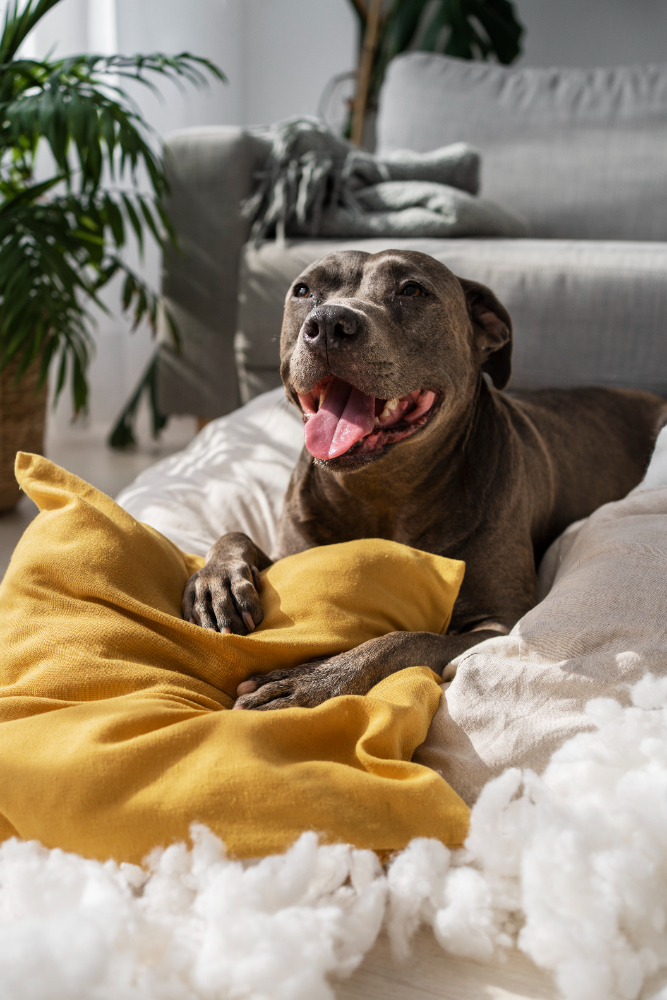
A Blue Staffy is a coat colour description, not a separate breed. When people talk about a Blue English Staffy, they generally mean a Staffordshire Bull Terrier with a blue-grey coat. Blue is included in the Dogs Australia Staffordshire Bull Terrier breed standard.
Here is where it can get confusing. An American Staffordshire Terrier can also have a blue coat, so an advertisement saying “Blue Staffy puppy” does not tell you which breed you are looking at. Ask whether the dog is a Staffordshire Bull Terrier, an American Staffordshire Terrier or a crossbreed, and check the documentation.
Our Blue American Staffy section explains the larger breed. You can also use the comparison table above to see the difference.
Why are Blue Staffies blue?
The blue-grey appearance comes from dilution of black pigment. Australian laboratory Orivet explains the coat dilution gene and how it is inherited. You do not need to become a genetics expert to choose a puppy, but it helps to understand that a colour description is not a new breed or a health guarantee.
Is Blue Staffy temperament different?
I would never choose a dog on the assumption that a blue coat makes it calmer, smarter or better with children. Look at the individual dog, the parents’ temperaments, health records and how the puppies have been raised.
A beautiful coat is lovely. You still have to live with the whole dog for many years.
Do Blue Staffies have skin problems?
Some dilute-coated dogs develop colour dilution alopecia, which can cause coat thinning and hair breakage. Orivet notes that not all dilute dogs develop it. Blue colouring alone does not diagnose a skin condition, and it is not a reason to assume every Blue Staffy will become unwell.
If your dog is losing hair, scratching or developing sore skin, start with your vet. There are several possible causes. Our guide to itchy skin in dogs explains why finding the cause matters more than repeatedly changing shampoos or food.
How big does an English Staffy get?
They’re not particularly tall dogs, but there’s a lot of dog packed into that relatively small frame.
The Dogs Australia breed standard gives a desirable height of 36 to 41 cm at the shoulder. Adult males are generally 13 to 17 kg, with females 11 to 15.4 kg.
They’re muscular, active and agile dogs with a short, smooth coat.
Of course, breed-standard weights aren’t a target weight for every family pet. Your vet is the best person to help determine a healthy weight and body condition for your individual dog.
How long do English Staffies live?
The average lifespan of a Staffordshire Bull Terrier is generally around 12 to 14 years.
That is a long commitment, which is something I always encourage people to think about before choosing any puppy.
You’re not just choosing the puppy sitting in front of you today. You’re choosing the adult dog they’ll become and taking responsibility for their training, health and wellbeing for hopefully many years to come.
What are Staffies really like to live with?
Many of the Staffies we meet are affectionate, playful and very people-focused. They often want to be right in the middle of whatever the family is doing.
They can also be incredibly enthusiastic.
That combination is one of the reasons I like getting their training started early.
A little Staffy puppy jumping up to say hello might not seem like much of a problem. It’s quite different when you’ve got a strong adult Staffy launching themselves enthusiastically at every visitor who walks through the front door.
Teaching calm behaviour, walking nicely on lead, coming when called and being able to settle are things I’d start working on from puppyhood.
But I’d never tell someone exactly what their dog will be like simply because it’s a Staffy.
Breed gives us useful information about likely characteristics, but it doesn’t write the whole dog.
Genetics, health, early experiences, socialisation, environment and everything the dog learns throughout its life all play a part.
After more than 35 years working with dogs, I think it’s far more useful to look at the individual dog standing in front of us.
Are English Staffies smart?
Yes. Staffordshire Bull Terriers are intelligent dogs and many are very engaged with their owners.
But smart dogs don’t automatically arrive knowing how we want them to behave.
A Staffy can quickly learn that sitting calmly earns something they want.
They can just as quickly learn that pulling gets them to an interesting smell, jumping gets attention, or stealing something starts a fantastic game of chase around the house.
Dogs repeat behaviours that work for them.
That’s why we concentrate on teaching and rewarding the behaviours we actually want rather than waiting for the dog to get things wrong.
Are Staffies good family dogs?
They certainly can be.
Many Staffies live very happily as part of families and love being involved in everyday family life.
But I want to be careful here because Staffies have historically been described as “nanny dogs”, including in a lot of older breed information.
I don’t think that’s a particularly helpful description.
No dog should ever be expected to look after a child.
An adult should actively supervise interactions between children and any dog, regardless of breed. When that is not possible, use secure physical separation. RSPCA Australia’s guidance on introducing dogs and children explains this approach.
Children should learn to respect a dog’s space and leave them alone when they’re eating, sleeping or trying to move away. The dog should also have somewhere quiet they can go when they don’t want to interact.
And remember that Staffies are strong, enthusiastic dogs. A very friendly Staffy can knock a small child over without having the slightest intention of hurting them.
This isn’t really a Staffy rule.
It’s a dog rule.
Are Staffies aggressive?
This is one of those questions where a simple yes or no answer doesn’t do dogs any favours.
You cannot reliably decide how an individual dog will behave simply from its breed.
We see Staffies that are very comfortable around people and other dogs. We also see Staffies that are reactive, frustrated, over-excited, worried or simply prefer having some space.
Behaviour is more complicated than “good breed” or “bad breed”, and aggression is more complicated than blaming a bad owner.
What matters with a Staffy is that they’re physically strong. If you have a strong dog barking, lunging or pulling towards another dog, it can become difficult to manage very quickly.
I’d much rather address those behaviours early than wait until the dog has been practising them for a couple of years.
If your Staffy is barking, lunging, freezing or becoming overwhelmed around dogs or people, our In-home Behaviour Training allows us to look at what is actually happening and put a practical plan in place for that individual dog.
How should I socialise my Staffy puppy?
Socialisation is incredibly important, but it doesn’t mean your Staffy puppy needs to meet every dog and every person they see.
Good socialisation is about safe, positive experiences. RSPCA Australia’s puppy socialisation guidance supports gradual exposure without forcing a puppy to interact. Ask your vet how to balance early learning with vaccination and local disease risks.
We want puppies learning about different people, dogs, sounds, surfaces, environments, handling and everyday life without continually overwhelming them.
Sometimes one of the most useful things we can teach a dog is that another dog can walk past and absolutely nothing needs to happen.
Your puppy doesn’t need to say hello to everybody.
They need to learn how to be comfortable in the world around them.
Our Puppy School is designed for puppies from 8 to 18 weeks of age and is run indoors in veterinary clinics, giving puppies and their owners a controlled environment in which to begin building those foundations.
Are Staffies easy to train?
They can be great fun to train.
They’re intelligent, often enthusiastic and many love working with their owners.
For a young Staffy, I’d concentrate on practical things you’re actually going to use in everyday life:
- walking nicely on lead
- coming when called
- settling calmly
- greeting people without jumping
- handling
- giving things up willingly
- being comfortable around other dogs without needing to greet them
- being comfortable spending reasonable periods alone.
I also want a young dog to learn that they don’t have to be doing something every second of the day.
Being able to settle is a skill too.
Reward the behaviours you want and make it worthwhile for your dog to repeat them.
How much exercise does an English Staffy need?
Staffies are generally active dogs, but I don’t believe in giving every dog of a particular breed an arbitrary number of minutes they must exercise each day.
Look at the dog in front of you.
Age, physical condition, health, fitness and the weather all matter.
Walking, sniffing, training, exploring and appropriate play can all contribute to meeting a dog’s needs. Mental stimulation is important as well.
A young puppy obviously shouldn’t have the same exercise program as a fit adult Staffy, and an older dog may need things adjusted again.
Exercise also isn’t the answer to every behavioural problem.
If your Staffy is digging, escaping, destroying things or distressed when left alone, simply trying to exhaust them with another vigorous walk may not address what’s actually causing the behaviour.
Make sure your yard and home are secure, but more importantly, work out why the behaviour is happening.
Can Staffies live inside?
Absolutely.
In fact, most of the Staffies I’ve worked with would probably vote very strongly in favour of being wherever their people are.
You don’t necessarily need an enormous property to give a Staffy a good life. Appropriate exercise, enrichment, training, companionship and a secure environment are considerably more important than simply having a big backyard.
And a backyard by itself doesn’t exercise a dog.
A bored dog left outside to entertain themselves can become very creative, and you may not appreciate their choice of hobbies.
Can Staffies be left alone?
Yes, but being comfortable alone is something I like puppies to learn gradually.
It’s very easy with a new puppy to have someone with them virtually every minute. Then eventually everyone returns to work, school and normal life and the puppy suddenly has to cope with being alone.
I’d rather build that independence gradually from the beginning.
If your Staffy is showing genuine distress when you leave, that’s different from simply being bored or preferring your company.
Separation-related behaviour can be complicated, and it’s worth getting professional help rather than assuming the dog is being naughty.
Do English Staffies shed?
Yes.
Their short, smooth coat is relatively easy to maintain, but short-haired certainly doesn’t mean no shedding.
Regular brushing will help remove loose hair and their nails, teeth, ears and skin still need the same regular attention you’d give any other dog.
Anyone who has owned a short-coated dog also knows those little hairs have an amazing ability to work their way into carpet, furniture, clothes and sometimes even your feet.
We’ve written more about why this happens in Why Do Some Dog Hairs Feel Like Tiny Spears in Your Feet?
What about Staffies and skin problems?
We certainly see Staffies with itchy or irritated skin, but “my Staffy is itchy” isn’t a diagnosis.
There can be a number of reasons a dog is scratching, licking their feet, developing recurrent ear problems or experiencing skin irritation.
Rather than continually changing foods, shampoos or trying whatever remedy somebody recommends online, talk to your vet and work out what’s actually causing the problem.
We have a more detailed article on this as well: How to Treat & Prevent Itchy Skin in Dogs.
What health problems should Staffy owners know about?
Like all breeds, Staffordshire Bull Terriers can be affected by particular inherited conditions.
If you’re buying a puppy, I’d encourage you to ask the breeder about health testing rather than simply choosing a puppy because you like its colour or because it’s available immediately.
Two hereditary conditions Staffordshire Bull Terrier owners and breeders should know about are L-2-hydroxyglutaric aciduria (L2-HGA) and hereditary cataracts (HC). DNA testing is available for both.
Australian laboratory Orivet’s Staffordshire Bull Terrier testing profile lists L2-HGA testing, including a second variant, and hereditary cataract testing. Ask your vet and testing laboratory which variants have been assessed, rather than assuming that every certificate covers the same panel.
L2-HGA is an inherited metabolic disease that can affect the nervous system. Hereditary cataracts affect the lens of the eye and may impair vision. Orivet’s hereditary cataract information explains the relevant DNA test and why clinical eye examinations remain useful.
Request the parents’ identifiable test certificates and an explanation of the mating. A carrier can appear healthy, so appearance is not a substitute for test results. “Clear” applies to the tested condition and variant, not every inherited illness. Ask for evidence supporting any claim of clear by parentage.
This differs from the Amstaff’s NCL4A cerebellar ataxia testing, described in our American Staffy health section. Do not assume the same genetic tests apply to both breeds. Discuss joint health, eye examinations and any family history of illness with your vet as well.
Ask about the parents, temperament, relevant health testing, how the puppies have been raised and what experiences they’ve had before coming home with you.
A responsible breeder shouldn’t be annoyed that you’re asking questions.
They should be pleased that you care enough to ask them.
Bringing your Staffy puppy home
The first few weeks with a puppy can make a tremendous difference.
Think about toilet training, sleeping, feeding, boundaries, safe areas, chewing, biting, interactions with children and other pets, and how you’re going to gradually teach your puppy to spend some time alone.
Our Puppy Set-up is an in-home session designed specifically for puppies from 8 to 18 weeks. We look at your puppy, your home and your family and help you put practical routines and foundations in place from the beginning.
Prevention is usually much easier than trying to undo a problem once it has become established.
Training your Staffy in Brisbane
We’ve trained a lot of Staffordshire Bull Terriers over the years, and the right type of training depends on the age of your dog and what you need help with.
For puppies from 8 to 18 weeks, our Puppy Pre-School helps owners get the early training and socialisation foundations in place.
For dogs from five months of age, our Group Obedience Training focuses on practical skills including lead manners, recall, calm behaviour and working around distractions. The initial course runs for three consecutive weeks and, once completed, your dog receives lifetime membership, allowing you to return to our group obedience classes for the life of that dog.
For behavioural problems such as reactivity, aggression, separation-related behaviour, excessive barking or other issues that need individual attention, our In-home Behaviour Training allows us to assess the dog in its own environment and develop a plan specifically for that dog and family.
Is an English Staffy the right dog for you?
Staffies can be wonderful dogs.
They’re often affectionate, funny, intelligent and incredibly enthusiastic about being part of the family.
But don’t choose one simply because you like how they look or because somebody has told you they’re the perfect family dog.
Think about the individual dog and whether you can provide the training, exercise, companionship and care that dog will need for the next decade or more.
We’ve had the pleasure of working with a lot of Staffies over the years at Jordan Dog Training.
Give them good foundations, sensible training and the opportunity to be part of the family, and they can be absolutely terrific companions.
Give your Staffy a pat from us.
More breed profiles:
Staffies in the news: keep the breed names clear
Serious dog attacks deserve careful attention and compassion for everyone affected. At the same time, “Staffy”, “Staffy cross” and “Pit Bull” are often used loosely. A reported label or a photograph does not establish a dog’s pedigree or explain an incident.
The Australian Veterinary Association’s policy on breed-specific legislation supports individual assessment and recognises the interaction of inherited traits, experience, health and learning. That does not remove the responsibility to manage a strong dog safely.
If you see guarding, freezing, hard staring, growling or snapping, create distance and get advice. Avoid punishing warning signals or repeating an encounter to test the dog. Arrange a veterinary assessment for sudden behaviour changes. Behaviour around other dogs and behaviour around people need to be assessed separately.
Are English Staffies legal in Queensland?
As checked on 19 October 2026, the Staffordshire Bull Terrier and American Staffordshire Terrier are not named in the Queensland Government’s list of five prohibited breeds. The American pit bull terrier or pit bull terrier is listed. These names should not be treated as interchangeable.
Any individual dog may be declared dangerous or menacing based on its behaviour. Registration, identification, secure containment, local lead laws and any conditions applying to the dog still matter. Check with your council about your circumstances, particularly before moving or travelling interstate. This is general information, not a determination of a particular dog’s legal status.
Practical reading for Staffy owners
- Loose lead walking basics for comfortable everyday walks.
- Teaching “leave it” for turning away from items and distractions.
- Pit Bull and American Pit Bull Terrier terminology for a closer look at the names.
- RSPCA Queensland’s heatstroke advice. Adjust exercise to heat and humidity, provide shade and water, and seek urgent veterinary care for suspected heatstroke.
Breed, health, welfare and government sources were checked for this update on 19 October 2026. This profile provides general guidance and does not replace individual veterinary or behaviour advice.
Common questions about the English Staffy
Is a Blue Staffy an English Staffy or an American Staffy?
The colour alone cannot tell you. Both breeds can have blue coats. Check the breed name and documentation, then read our English Staffy versus American Staffy comparison.
How big does a Blue English Staffy get?
Blue is not a separate size category. The Staffordshire Bull Terrier measurements above apply regardless of coat colour. Your vet can help assess a healthy weight for your individual dog.
Can an English Staffy live in an apartment?
Some can, with suitable activity, toilet access, companionship and training. Consider noise, neighbours and how the dog copes alone. A large backyard is not a substitute for meeting those needs either.
Are Blue Staffies better family dogs?
Colour is not a useful way to decide family suitability. Look at the individual dog’s temperament and history, your children’s needs and whether adults can supervise and manage interactions safely.
About the author
Justin Jordan is the founder of Jordan Dog Training and has more than 35 years of experience working with dogs and their owners. This article draws on his practical experience training Staffies, from puppy foundations to adult obedience and behaviour support. Learn more about Justin and Jordan Dog Training.