
A good walk gives your dog more than exercise. There are smells to investigate, places to explore and time spent with you. The useful question is whether the outing suits the dog in front of you.
A busy street walk might be enjoyable for one dog and overwhelming for another. Age, health, fitness, weather and confidence all matter. A longer walk is not automatically a better one.
What is a decompression walk?
People often use “decompression walk” to describe a quiet, low-pressure outing with time to sniff and explore. It is a practical description, not a medical treatment or a guarantee of lower cortisol, better sleep or a change in behaviour.
You can include sniffing time in an ordinary walk too. Your dog does not need a remote paddock or a long line to benefit from exploring at a comfortable pace.
Movement, sniffing and everyday skills
Appropriate exercise supports physical wellbeing, while opportunities to sniff and investigate provide enrichment. Walks can also be a chance to practise useful skills, such as moving with you on a loose lead or stepping aside for someone to pass.
Mix those activities to suit your dog. A few minutes of training followed by time to explore may work well. Constantly asking for a heel position can leave little room for investigation, while allowing unrestricted movement beside a road would be unsafe.
Our guide to loose lead walking explains how to build comfortable walking skills. For more about your dog’s nose, see how dogs smell.
How to plan a quieter walk
- Choose a suitable place and time. Look for enough room to avoid crowding, traffic and unwanted dog greetings. Check that dogs are permitted and follow local access and lead rules.
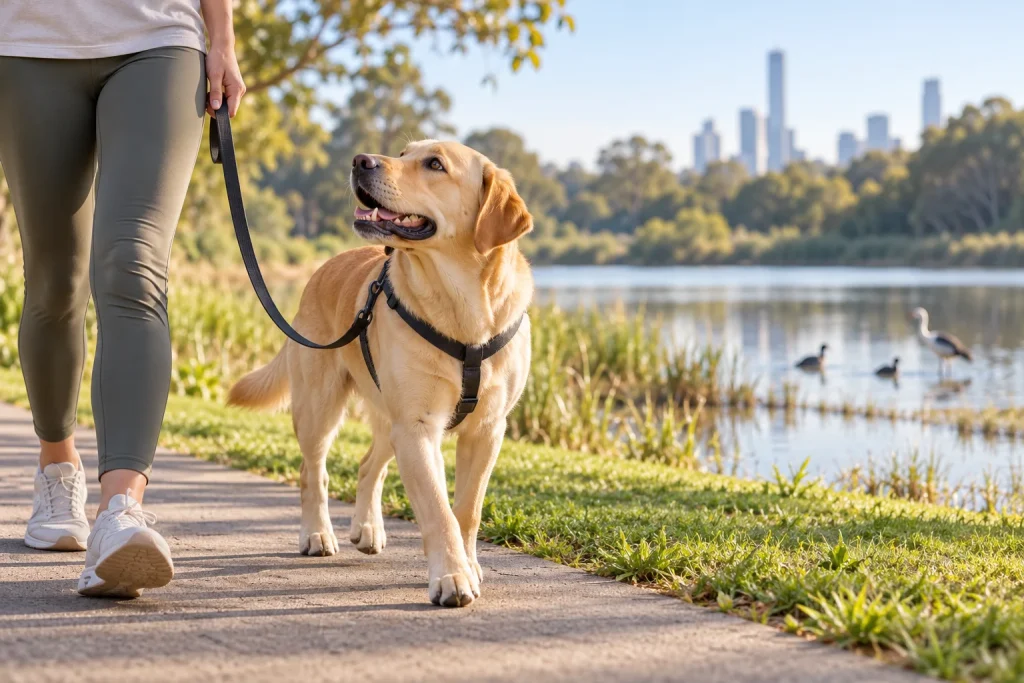
- Use equipment for the setting. A well-fitted harness and suitable lead can give your dog room to explore. Use a long line only where it is permitted and you can manage it safely, away from roads, bikes, wildlife and other dogs. Keep control of the line and avoid entanglement.
- Allow some choice. Let your dog pause and investigate safe smells. Gently move on from rubbish, unsafe plants or anything they might swallow.
- Watch how your dog is coping. Notice the whole body. Repeated scanning, freezing, frantic pulling or attempts to leave mean the outing needs adjusting. Sniffing alone does not prove a dog is relaxed.
- Finish before it becomes too much. Turn back, create distance or head home when needed. There is no requirement to complete a set route.
How long and how often?
There is no single walking schedule for every dog. Discuss exercise with your vet if your dog is growing, older, unfit, unwell or recovering from an injury. Follow any prescribed restrictions.
For puppies, build activity gradually and ask your vet about local disease risks and suitable outings before their vaccination course is complete. For dogs who become frightened or reactive outside, a quieter setting and behaviour support may help more than adding distance.
In Brisbane’s hot or humid weather, reduce exertion and change plans when needed. Heavy panting, breathing difficulty or weakness require prompt action. Read our heatstroke guidance before heading out.
When an ordinary walk is not suitable
Some dogs need a temporary break from neighbourhood walks for medical or behavioural reasons. That does not remove their need for activity, enrichment and contact. Work with your vet or behaviour professional on suitable alternatives, such as gentle exploration in a secure yard or simple scent activities at home.
Our rainy-day activity ideas include options you can adapt to your dog’s abilities. More walking is not a stand-alone solution for anxiety, aggression or unexplained behaviour changes.
Contact Jordan Dog Training if you need help making outings more comfortable and manageable.